
You know that thing you keep asking everyone about? The thing you’ve analyzed from every possible angle, talked about with your friends, replayed in your head and probably Googled more than once? You probably already know what you think. The problem isn’t always finding the answer. Sometimes the problem is trusting yourself enough to do something about it.
If you read my last article, When You Already Know the Answer, you may have found yourself thinking about something you already know but haven’t quite wanted to admit. Maybe it’s a relationship, a friendship, a decision you’ve been putting off, or something in your own life you’ve been circling because acknowledging the truth would mean actually doing something about it.
When “Confused” Really Means Uncomfortable
I think this is where a lot of us get stuck. We can be incredibly clear when we’re giving advice to someone else. We can see their situation from the outside, and suddenly everything makes sense. We can tell our friend that they deserve better, that they need to stop chasing someone who isn’t showing up, that they aren’t (or are) imagining things, or that they have every right to set a boundary.
Then it’s our turn. Suddenly, we’re confused. Maybe we’re overreacting. It could be we’re being too sensitive. Perhaps we’re expecting too much. Maybe even the other person didn’t mean what they said or did “that” way. Maybe we should give them another chance.
Sometimes we do need to question ourselves. Not every uncomfortable feeling means something is wrong, and not every disagreement is a red flag. But there’s a difference between thoughtfully questioning yourself and constantly overriding yourself. Sometimes what we call “confusion” is admitting that we know the answer would require us to change something. And change can be uncomfortable.

Pay Attention to the Signals
We spend so much time looking for the big flashy sign that we miss the smaller signals we’re getting every day. The knot in your stomach, the resentment that keeps coming back, the conversation you keep having with yourself, or the boundary you know you need but keep negotiating away. One moment doesn’t tell you everything. Patterns usually tell you much much more.
This is especially true in both romantic and platonic relationships. When you care about someone, you naturally want to see the best in them. You remember the good moments. You think about their intentions. You consider what they might be going through. All of that can be true while something still isn’t working for you. You don’t have to prove that someone is a bad person before admitting that a relationship isn’t good for you.
Stop Looking for Permission
I think we sometimes make things harder because we believe we need a really good reason before we’re allowed to make a difficult decision. We collect evidence as though we’re preparing for a court battle. We list everything that happened and explain every conversation, hoping to build an argument that will make our decision acceptable to everyone else. But your life isn’t a courtroom.
You can listen to someone else’s perspective and consider whether you misunderstood something. You can definitely own your part in a situation, and you can even change your mind BUT you don’t have to keep handing over the final decision about your own life to everyone around you. Your power should be your own, so take it back.
Full disclosure, I’ve caught myself doing this too. I can be very clear about what I think someone else should do, then suddenly become an accomplished overthinker when it’s time for my decision. It’s amazing how quickly “I know exactly what I’d tell a friend” becomes “but maybe I should think about this for another six months.” Sometimes that’s not wisdom, rather, it’s fear disguised as “I just need more clarity.”
Self-Trust Doesn’t Mean You’re Always Right
We also put an enormous amount of pressure on ourselves to make the right decision. We want guarantees that we won’t regret it, that the other person will understand and that everything will work out. Unfortunately, life doesn’t really work that way. You know that there are decisions you will make without knowing exactly what comes next. You’ll walk away from people and still miss them. You will set boundaries that someone else won’t like or be comfortable with. It’s not easy but sometimes necessary.
Feeling sad about a decision doesn’t automatically mean it was the wrong decision. It comes down to self-trust. It’s not about believing you’re always right. No, it’s about knowing that you can listen to yourself, make a decision, learn from it and handle whatever comes next. You will make choices you later question, stay longer than you should in a situation, and you will certainly misread people… we all do that. That’s being human. The goal here isn’t perfection. It’s knowing that you can trust yourself enough to keep going.
Maybe You Don’t Need More Clarity
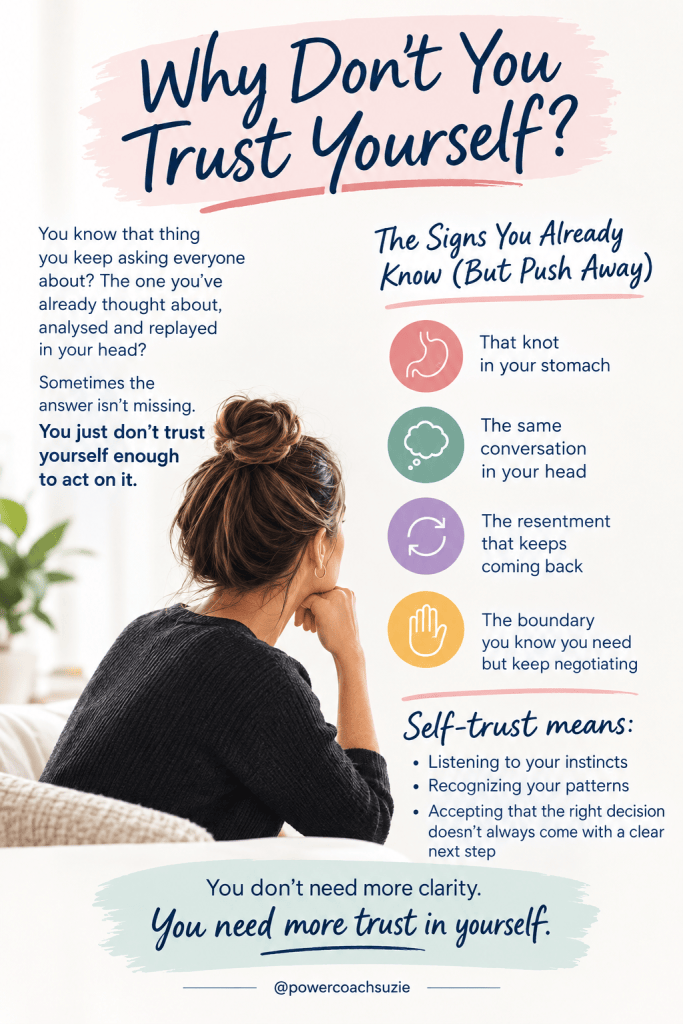
You don’t need a crisis to justify making a change or wait until you’re completely exhausted, furious or heartbroken before you’re allowed to set a boundary. Turning someone into a villain so that you can finally give yourself permission to walk away isn’t necessary, even if it feels easier to do it. It’s ok to simply know that something has changed, it could even be that you’ve changed and people can grow in different directions. Maybe your standards have changed and what was once tolerable or acceptable isn’t anymore. That’s totally ok. That’s allowed.
So the next time you catch yourself asking five different people what they think about something you’ve already been thinking about for weeks, stop for a second. Ask yourself what you think. Not what your friend thinks. Not what social media says you should do. Not what you think you’re supposed to want. What do YOU think? And then ask yourself an even harder question: What would I do if I weren’t so afraid of being wrong?
Trusting myself has become less about having all the answers and more about knowing I’ll be okay, no matter the outcome. It took time to get here, it’s a process but an intentional one. In Self-Trust and How to Build It, Linda Bloom and Charlie Bloom talk about self-trust as having confidence that you’ll treat yourself with kindness and respect, even when you make mistakes. That really resonates with me because I used to beat myself up when I made a bad choice, but now I focus on the lesson rather than the mistake. And as Paul J. Dunion writes in Developing Self-Trust, self-trust also comes from being honest with yourself while extending yourself compassion. The more I learn to do both, the easier it becomes to trust my instincts, make decisions with confidence, and move forward without second-guessing every step. This has really helped me make those hard choices I never wanted to do and empower myself.
You might not have the whole answer. It’s a scary decision, and that’s okay. You don’t have to have everything figured out to start trusting yourself again. Maybe the question isn’t, “How do I know if I’m making the right decision?” Maybe it’s, “Why am I having such a hard time trusting the answer I already have?” Because sometimes the clarity you’re looking for isn’t missing, you already know. You’re just not ready for what that clarity might ask you to do because trusting yourself completely means taking your power back. So are you ready to take back your power?
One.Step.At.A.Time.
Suzie
Listen to the Conversation
These are the kinds of conversations we’ll be exploring in this season of Signals & Standards with Suzie. Together, we’ll dive deeper into self-trust, emotional clarity, personal growth, relationships, boundaries, and the standards that shape our lives. Because sometimes the most important shift is learning how to listen to and trust what you’ve known all along.
Visit PowerCoachSuzie.com to learn more and join the conversation.

